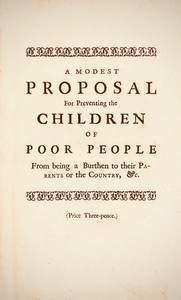
A Modest Proposal
A practical guide—then open the legal full text when you're ready.
Reading guide
Who it’s for, why read, how to read, what you’ll gain—skim before you commit hours to the text.
AI-assisted draft, checked before publish. Use it to decide and start—not as a substitute for the book or scholarly citation.
Who it's for
This short essay suits readers who enjoy satire, classic essays, and writing that says one thing while meaning another. It is also a good pick for students of English who want a famous text they can finish in one sitting. Readers curious about eighteenth-century Britain and Ireland will find the background rewarding. The language is older than modern English, so some patience with long sentences helps.
Why read it
Swift wrote this piece as a sharp attack on how the poor of Ireland were treated by landlords, politicians, and comfortable society. Its famous trick is that the narrator calmly proposes something horrifying, and the horror is the point. Reading it now shows how irony can expose cruelty that polite language hides. It is also short, quotable, and part of the shared vocabulary of English satire. You will see why it is still taught and still argued about.
How to read
- Learn a little about poverty in eighteenth-century Ireland first, so the target of the joke is clear.
- Read once straight through for the shock, then go back to key paragraphs.
- Keep asking: what does the narrator say, and what does Swift actually want me to feel?
- Do not take the extreme proposal as the author's real opinion; watch for the gap between voice and intent.
- Use a guided introduction or notes if the historical references feel distant.
- Save film or stage adaptations for after you have formed your own reading.
What you'll gain
- A clear model of how irony works and how to spot it in other writing.
- A sense of an important moment in Irish and British history.
- Practice separating a narrator's voice from an author's purpose.
- A short classic you can discuss with confidence, plus a question worth carrying: what would this kind of satire target today?
Next step: open the real book
This page is the guide; Project Gutenberg holds the legal text.
We do not host unauthorized commercial ebook files. Prefer official public-domain sources. Legal reading guide.